
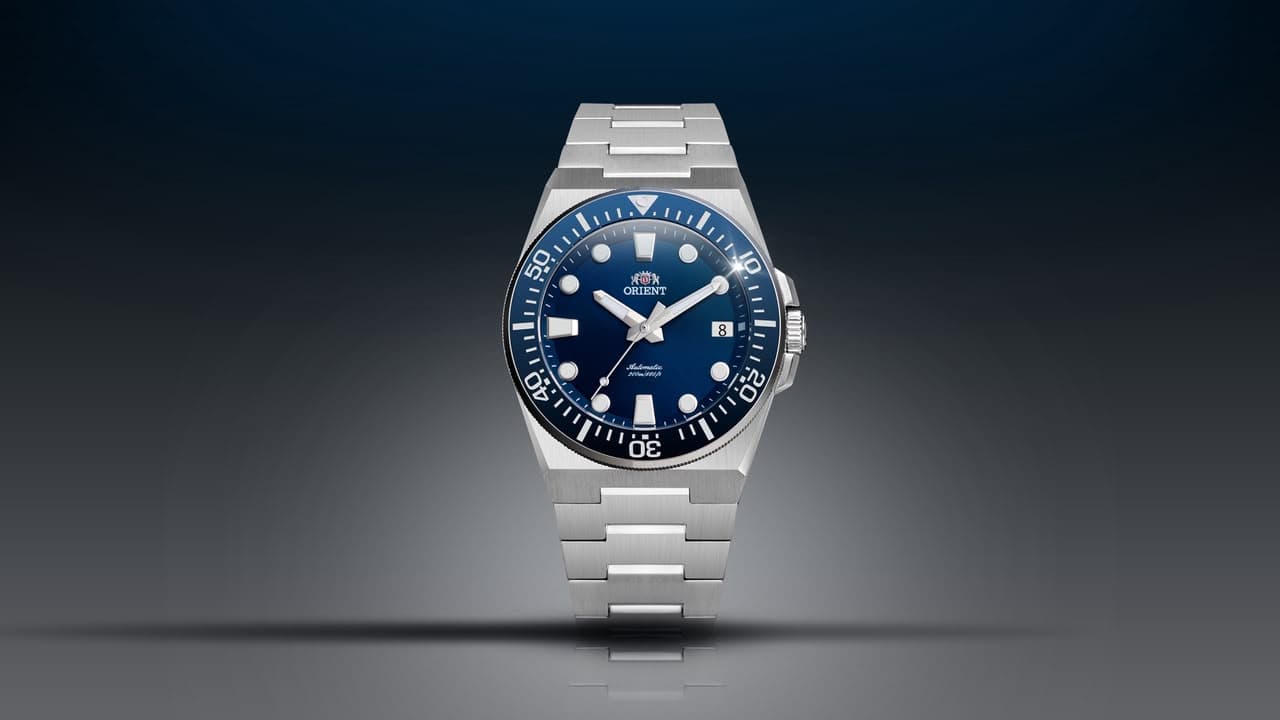
The new Orient watch with an integrated bracelet puts this question on the table. From the promotional images, the brand combines an angular case and a wide- links bracelet with elements familiar from the design language of dive watches: graduated bezel, robust hands , prominent hour markers , and a date display at three o'clock.
It's an interesting combination. The geometry of the case gives structure to the whole, while the circular bezel breaks the rigidity of the lines. The bracelet extends the surfaces of the case and directly contributes to the watch's identity. Removing it from this composition would change an important part of its personality.
That's where the difference begins between liking an integrated watch and simply liking a bracelet.
In a project of this type, the case and bracelet need to communicate. The width of the first links, the reduction towards the clasp, the articulation, and the way the surfaces reflect light all influence the perception of the entire piece. The integration can be visually convincing in photographs and less successful when the watch needs to hug a real wrist.
Therefore, I consider comfort the decisive point in this discussion. A first link with limited mobility can increase the effective reach of the watch. A clasp without sufficiently fine adjustment can leave the watch too tight or too loose. These are details that no promotional image can resolve and that, in the case of this Orient watch, deserve an in-person evaluation before any conclusions are drawn about ergonomics.
The photograph allows for analysis of the proposal. Comfort requires coexistence.
There's also a trade-off the buyer needs to accept: the more specific the fitting, the greater the potential dependence on compatible straps. Even with a quick-change mechanism, ease of bracelet removal and the freedom to install any strap are different things. For those who like to customize their watch with leather, rubber, or fabric, this is a significant factor.
None of this diminishes the merit of the proposal. It merely serves as a reminder that integration is a design choice with practical consequences.
In the case of this release, what interests me is the combination of the visual continuity of the bracelet and the sporty presence of the dial. There is a lot of detail on the front, but the case creates a defined frame for it. In the blue version shown in the images, the color further softens the more industrial feel of the links and brushed surfaces.
My take is that Orient has found a combination with potential, although the design alone is not the final word in evaluating the design.
And the trend? For me, participating in popular language doesn't disqualify a watch. Watchmaking works continuously with references, repetitions, and interpretations. The problem arises when we recognize the formula before seeing the product—and allow familiarity to replace our judgment.
An integrated bracelet doesn't automatically make a watch more sophisticated. That perception needs to be supported by the finish, the proportions, and the quality of the workmanship. It also doesn't make sense to reject an interesting piece simply because many people have come to like that style.
Is it worth following a trend? It's worthwhile when it aligns with your taste and works on your wrist. In this Orient, I see a visual design that deserves attention and an overall look that calls for in-person inspection to see if it delivers the same coherence in wear.
Before buying, I would ask myself a simple question: if integrated watch bands disappeared from social media tomorrow, would I still want this watch?
If the answer is yes, perhaps the trend has simply helped you discover what you like.

About the author
Wallace Palhares
Collector and founder of Ponteiro Urbano. I write about watches, travel, and horology fairs around the world.